
Click the arrows next to titles to read artwork descriptions. Click the images to view in a separate tab at full size.
'Tiktaalik' and 'Tiktaalik roseae' are used interchangably throughout, as the genus is monospecific.

Mortichnium - May 2025 (final piece)
This description is taken directly from my A-level exam project sketchbook.
From Latin mors ('death') and Ancient Greek íkhnion ('footprint'), a mortichnium is the trail left by a dying animal preserved as a fossil.
The most notable example of this fossil is that of an ancient horseshoe crab relative, Mesolimulus walchi. This trail was left when the animal fell in to anoxic water and failed to escape before being starved of oxygen.
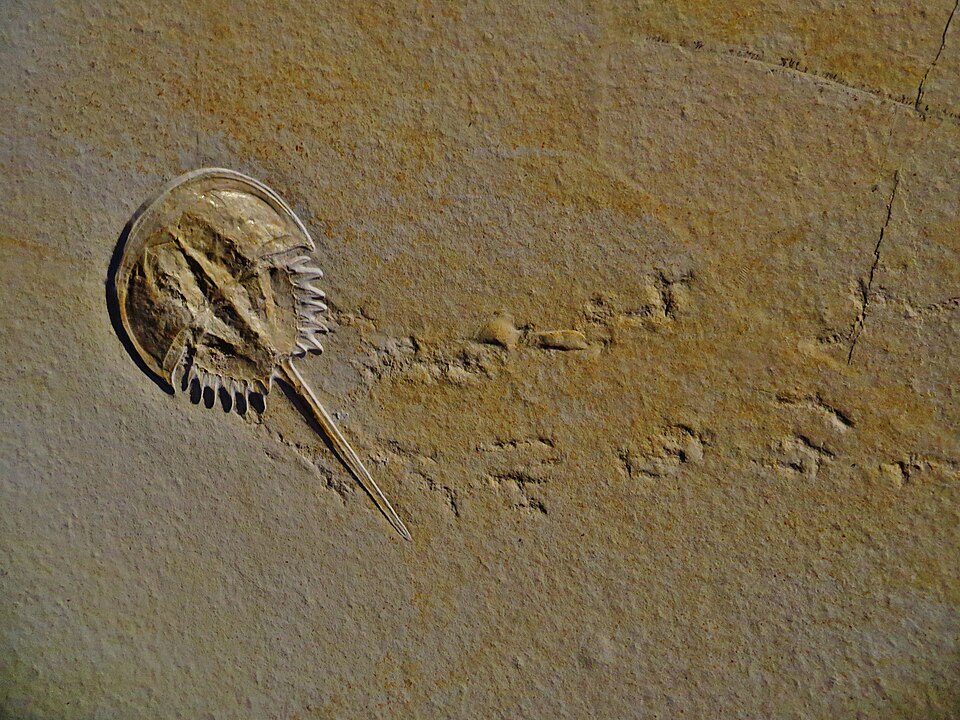
Image of the Mesolimulus walchi mortichnium (from Wikimedia Commons).
The animal's last steps are tragic — its desperation to return to a time past, a fear of death, all evident in its scrambling prints.
Humans, equally, are desperate to escape the present. As the M. walchi attempted to right itself and return to the shore, so too does the human mind linger on past memories. Unfortunately, both are doomed to fail — resurfacing is impossible.
The piece in the alloted 15-hour exam time will be a final faux-artefact in the form of a false fossil. The mortichnium of humanity and Tiktaalik as it becomes apparent that returning to the past is not attainable.
Since this piece marked the end of my A-level course, there wasn't any opportunity to write about it in retrospect. So, here are some additional details about this piece. It's approximately 60x90cm, painted using oils on wooden board. I used air-dry clay to sculpt the Tiktaalik fossil and a mixture of acrylic paint and baking soda to achieve the rough, faux-stone texture. Real fossils and shells are attached to this painting, most of which I found on a trip to Whitby, UK. It's still hanging above my desk.

Initial ideation - February 2025
These are the opening pages of my exam sketchbook. They function sort of as a rough thesis for the entire project, visually establishing the central parallel of ontogeny and phylogeny. Many of these sketches were made during the session in which the externally set themes were shared to my class. You can see that they're cut out of the exam paper itself, heehee.
Tiktaalik roseae
Tiktaalik roseae is an extinct species of lobe-finned fish that lived roughly 375 million years ago in modern-day Canada. It is thought to be a common ancestor of terrestrial vertebrates and the first ancestor of humans to walk on land.

Reconstruction of Tiktaalik roseae by Nobu Tamura (from Wikimedia Commons).
For the purposes of this externally set assignment (in response to the theme 'Walking'), Tiktaalik can be thought of as the 'protagonist'.
My characterisation of the fish is detached from palaeontological science; rather, it is an avatar to be envied, revered, and despised all at once. Tiktaalik is equally blamed for and credited with the evolution of humans and the consequences thereof.
Additional to the interpretation of Tiktaalik as a character, the fish being extinct offers me as the artist some visual liberties. I chose to depict Tiktaalik as green-scaled as allusions to envy and life. When viewed in retrospect, Tiktaalik is enviable due to its blissful ignorance. However, it can also be construed as worthy of reverence, an icon of ingenuity and an evolutionary pioneer. In truth, both perspectives are exaggerations of the true nature of the fish, which is just like that of any animal — to consume and reproduce.
In popular culture
Tiktaalik has been the subject of internet meme culture construing the fish's evolution as part of a chain of events that leads to all human suffering. Tiktaalik is characterised as the ultimate scapegoat, the root of all evil. It is a target of ironic hatred; the people creating and sharing these ideas do understand that the fish had no foresight of consequences, nor did it deliberately choose to evolve — rather, an element of dramatic irony is at play. The fish is depicted asclueless of what's to come, foolish in its ignorance.

A collection of Tiktaalik memes, circa 2020 (from Know Your Meme).
Though these memes are largely unserious, they are indicative of very real affects of individuals, especially during the COVID-19 pandemic when they first became popularised. More than mere complaint at modern malaise, Tiktaalik is an avatar of anemoia (nostalgia for a time and/or place that one has never known). These meme images ask the audience to imagine a different past, present and future. In this way, they resemble primitivism — 'my ass would have stayed in the primordial soup if I knew there was gonna be days like this' reveals a real longing for simplicity, romanticising life as a prehistoric creature. The fish is equal parts hated and envied, influencing my depiction.
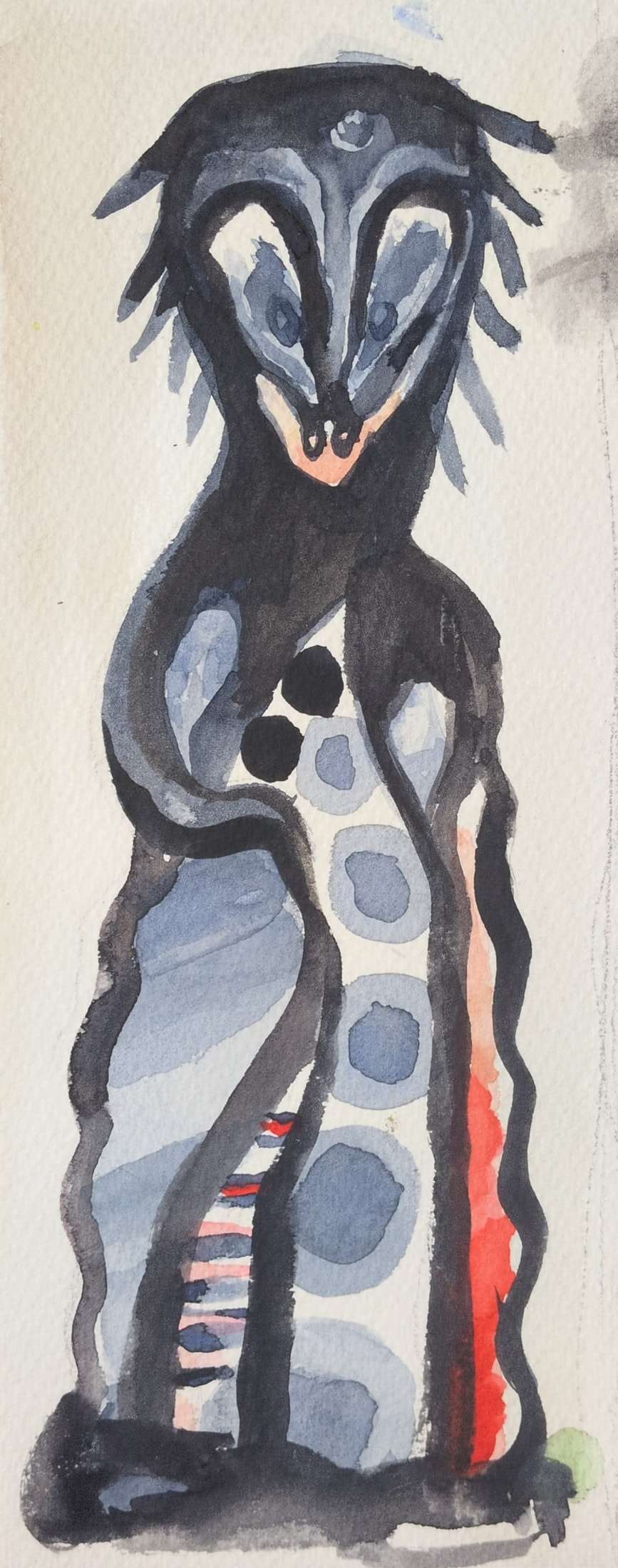
Pastiche of Dumuzi by C.M. Kösemen
Cevdet Mehmet Kösemen is a Turkish artist and researcher most famous for his 2006 speculative evolution project 'All Tomorrows:A Billion Year Chronicle of the Myriad Species and Mixed Fortunes of Man'. The book, originally released digitally, explores hypothetical future human evolutions through both natural means and genetic engineering.
Kösemen's work is both scientific and mythological, weaving elements of his palaeontological background with surrealism. The alien subjects appear ancient, depicted as prehistoric religious idols.
As Tiktaalik memes beg the question of an alternate evolutionary timeline, Kösemen's artistic method offers a solution. His work is soaked in an appreciation of the cultures of the ancients, the vastness of deep time, and the mechanisms of evolution.
Applying Kösemen-like speculation to Tiktaalik, I imagined a culture that deifies the fish. Whether it is revered or despised is left deliberately ambiguous throughout the series of 'faux-artefacts' produced. I began with a watercolour painting, Fish Idol, applying Kösemen's techniques that I studied with the pastiche [above].
View C.M. Kösemen's fine art here.
Fish Idol - February 2025
Fish Idol borrows stylistic influence from C.M. Kösemen. I allowed the pigments to guide themselves through the water and worked in layers to achieve a translucent effect. The fish itself flows, becoming its own water.
The translucency offers an ethereal quality — resembling something like an angel or water spirit. Tiktaalik is elevated to the mythological as opposed to its true nature as an ordinary animal.

Experiments (Tiktaalik's Guilt)
A collection of two watercolours and one mixed media piece (acrylic on top of watercolour).
Following on from Fish Idol, contrast of transluceny and opacity was on my mind. The translucent effect is water-like and ethereal, but also vulnerable and honest. Likewise, incorporating opaque black acrylic in twisting knots illustrates a web of sincerity and concealment. The continuous depiction of a green Tiktaalik alludes further to envy.
Primarily, these are evidence of development of visual language in characterizing the fish.

Surfacing - March 2025
Surfacing extends the translucent techniques borrowed from C. M. Kösemen with a watercolour base, with the addition of acrylics, coloured pencils, charcoal and dirt from outside my classroom.
To the imagined colour that deifies Tiktaalik, Surfacing is Genesis-adjacent. Here, Tiktaalik is the image of progress, as it breaches to a dry new frontier. The nature of that progress, however, is left ambiguous. Is Tiktaalik a revered ancestor, or a blight upon the land?
The direction in which the piece is oriented highly influences its appearance. As presented here, Tiktaalik rises from the water as though escaping a frightful abyss. However, turned over, Tiktaalik descends upon the earth like some harbinger of doom, drudging and galumphing down the shore. It pulls the wicked black water along with it.
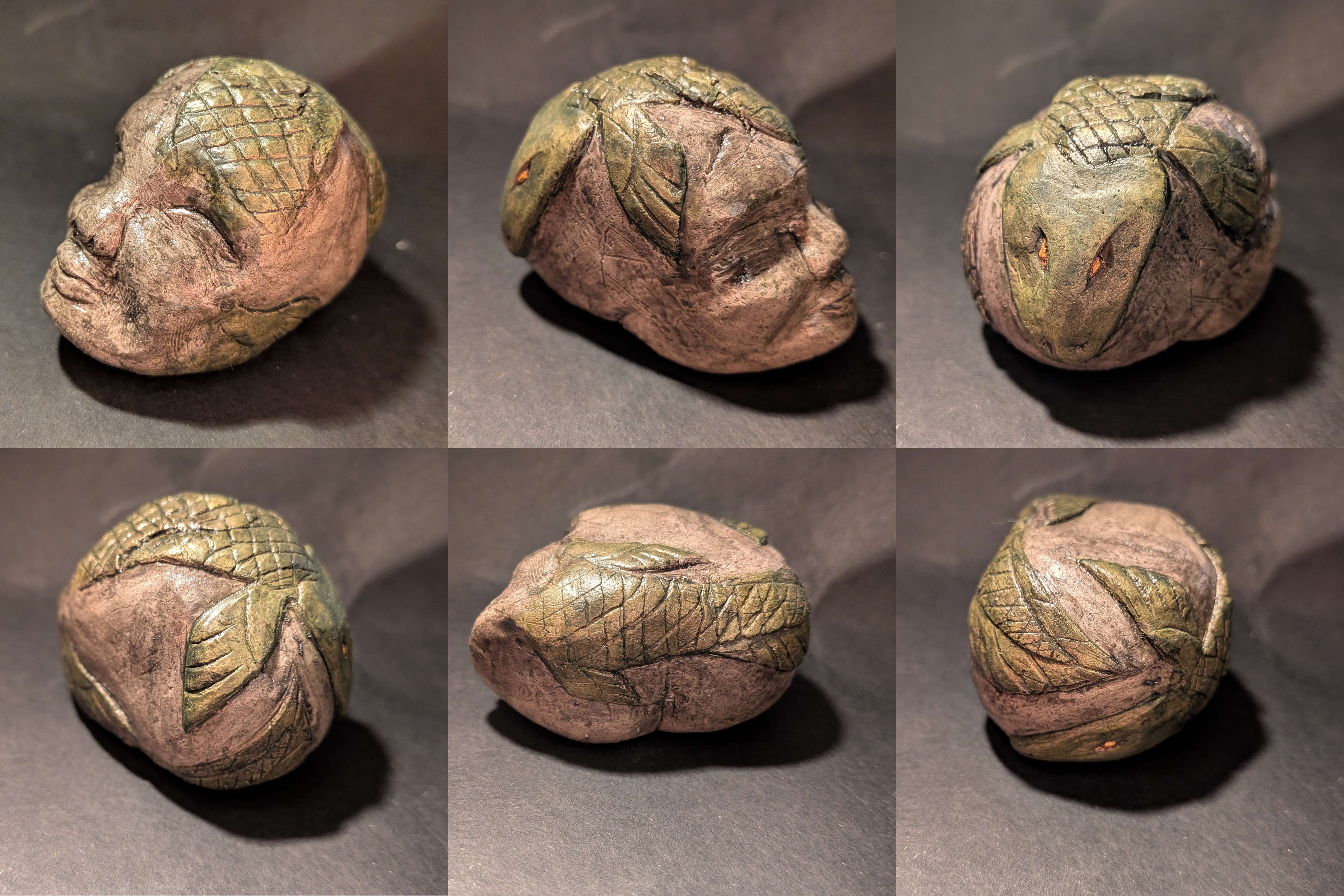
Fish Idol II - March 2025
Fish Idol II combines additive and subtractive sculptural techniques which I observed in artefacts at the Manchester Museum. It is an example of a faux-artefact, inspired partly by hoaxes that captured my imagination when I was young. The sculpture itself is small, approx. 4x5x6cm, fitting comfortably in the palm of the hand — something the imagined Tiktaalik deifiers may have kept as a personal item, perhaps like a worry stone or talisman.
The clay head was originally sculpted by my classmate, Will Curran, but he didn't end up using it in his project. I used a scalpel to carve the fish into the clay, producing a tactile scale texture. I used high-flow acrylics, which give the surface a smooth, glossy, and artificial finish, highlighting the inauthentic nature of the 'artefact'.
Tiktaalik both emerges from and embraces the head. It could be construed as clinging on like a parasite to its host, or as cradling and nurturing its descendant. The face is androgynous and ambiguous in expression.